

A Jaguar depends on its fluids staying at the right level, viscosity, and condition. On many mass-market cars, a fluid problem makes itself obvious well before anything serious happens. Jaguar’s tolerances are tight enough that old or low fluid can hurt a major system before a warning light ever comes on. Escondido German Auto has been in business in Escondido since 2011, and on a Jaguar, regular, thorough fluid inspections are one of the best ways we know to keep the car running the way it should.
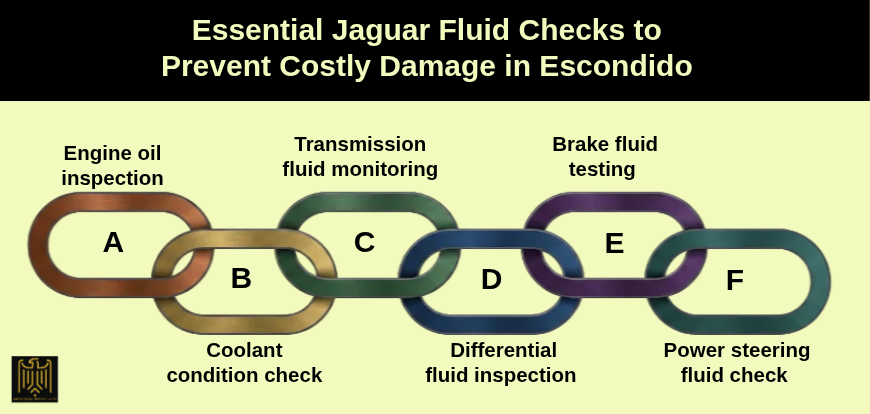
Engine Oil: Condition Matters as Much as Level
Most Jaguar owners know to check the oil level. Fewer check the oil’s condition, and it matters just as much. Jaguar’s supercharged and turbocharged engines run hot, and oil past its service life stops protecting the engine even when the dipstick reads full. Oil that looks very dark, gritty, or milky (milky means coolant is getting in) needs attention right away. The 5.0-liter supercharged V8 in many XF, XJ, and F-Type models is especially sensitive to oil quality, because its supercharger bearings and timing chain tensioners rely on steady oil pressure and the right viscosity. Checking the oil’s condition at every service visit, not only at oil changes, catches a developing engine problem before it turns into an expensive failure.
Coolant: Degradation and Electrolysis
Jaguar cooling systems use a specific coolant made to protect aluminum parts from corrosion. Once the coolant ages past its service life, or the wrong type goes in, its inhibitors run out and it starts corroding the parts it was meant to protect. The water pump housing, thermostat housing, coolant reservoir, and the passages in the aluminum block are all exposed to electrolytic corrosion as the coolant breaks down. A proper coolant inspection checks pH and conductivity as well as level and color, to see whether the coolant is still doing its job. Catch worn-out coolant early and you avoid the leaks and failures that follow once it starts eating aluminum.
Transmission and Differential Fluids
Jaguar’s ZF-sourced automatic transmissions and rear differentials carry fluid the factory often calls “lifetime fill,” and experienced technicians are skeptical of that label. Heat cycles darken and wear out transmission fluid. Fluid that is dark or smells burnt means the clutch packs and friction surfaces inside the transmission have been shedding material into it. The differential fluid in Jaguar AWD systems, and in the rear differential of rear-wheel-drive models, also needs a periodic look, especially on a car that gets driven hard. A fluid inspection should include a visual and condition check of both, so worn transmission fluid is caught before it causes rough shifts or early clutch pack wear.
Brake Fluid and Power Steering Fluid
Brake fluid is hygroscopic, meaning it pulls moisture from the air over time. That moisture lowers the fluid’s boiling point and weakens the brakes under hard use. Jaguar’s performance models are especially sensitive to brake fluid condition, because hard, hot stops are part of how they’re meant to be driven. A moisture test on the brake fluid takes seconds and tells the technician whether it’s still within safe limits. In older Jaguars with hydraulic power steering, the steering fluid also breaks down with heat and age, and left too long it softens seals, wears the rack, and causes rack leaks.
Jaguar Maintenance at Escondido German Auto
Our shop is at 1554 East Grand Avenue. We provide full service for BMW, Mercedes, Audi, Porsche, and Volkswagen, and maintenance and basic services for Jaguar, for drivers throughout Escondido, San Marcos, Poway, Rancho Bernardo, and the surrounding communities. Our factory-trained, ASE-certified technicians use manufacturer-approved equipment. To have your Jaguar’s fluids checked, request an appointment.
FAQ
Q: How often should a Jaguar’s fluids be inspected?
A: Engine oil should be checked monthly or before any long trip. Coolant, brake fluid, and transmission fluid should be inspected at every scheduled service interval listed for your model.
Q: Can I use any coolant in a Jaguar?
A: No. Jaguar specifies a particular coolant formulation designed for its aluminum cooling system components. Using the wrong coolant can accelerate corrosion and cause leaks at the water pump, coolant reservoir, and aluminum engine passages.
Q: What does milky engine oil mean in a Jaguar?
A: Milky or frothy oil indicates coolant contamination, which typically points to a head gasket failure, cracked cylinder head, or in some cases a failed oil cooler. Have it looked at right away, because driving with coolant in the oil quickly damages the bearings and cylinder walls.
Q: What Jaguar work does Escondido German Auto do?
A: On Jaguars, Escondido German Auto provides maintenance and basic services, which include fluid inspections and fluid service like the checks described above.