
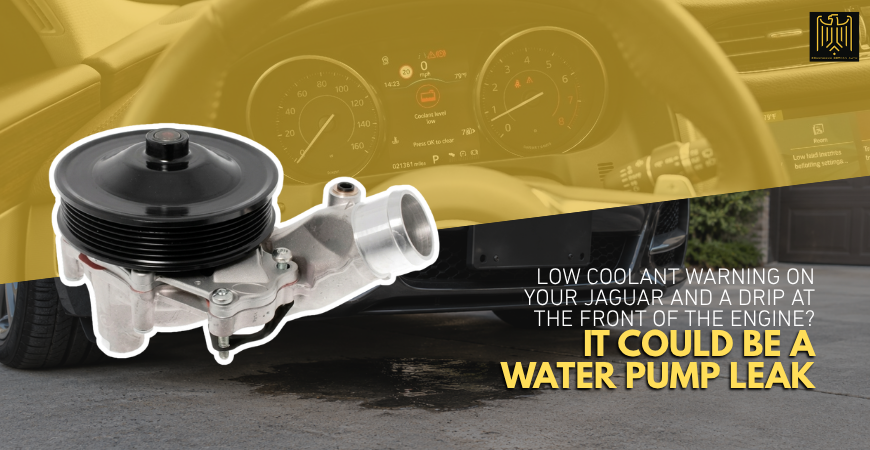
Jaguar wrote a bulletin for exactly this complaint. On the 3.0 supercharged V6 and the 5.0 V8, a “Low coolant level” message plus wet coolant at the front of the engine can trace to a water pump leak, with a worn bearing behind it. It can hide well in Escondido. Cool North County mornings can keep the drip small until the engine is hot, so get it checked before the Thanksgiving drive, not halfway up the grade on I-15.
Quick Summary: Key Takeaways
- Residue alone isn’t a leak: Jaguar calls dry crust on the pump normal.
- A fresh wet drip is: wet coolant dripping from the pump, plus a falling expansion tank, points to a real leak.
- The models in Jaguar’s bulletin: XF, XJ and XK from 2010 and F-TYPE from 2014, with the 3.0 supercharged V6 or a 5.0 V8.
- The bearing gets its own check: with no leak found, Jaguar has the tech listen at cold start, then feel the pulley for play.
Jaguar’s Own Bulletin Ties the Low Coolant Message to the Pump
The connection comes straight from Jaguar. Bulletin JTB00278NAS2, reissued in March 2014, covers 2010-onward XF, XJ and XK models and 2014-onward F-TYPEs with the 3.0-liter supercharged V6 or a 5.0-liter V8. It describes the expansion tank dropping below minimum, or the low coolant message coming on. Jaguar’s explanation is mechanical. Coolant can work its way into the pump’s bearing housing, the bearing corrodes, the impeller shaft loses proper support, and the seal face wears until coolant gets out.
That links the leak to the bearing. The pump runs off the auxiliary drive belt, which is why the bearing check involves slipping that belt aside.
A Weep Is Normal, a Drip Is Not
Most owners don’t expect this part. Jaguar expects a little coolant on the pump. During normal operation a small amount can temporarily weep through the seals or from the pump’s evaporation chamber, leaving dry crust on the body, the pulleys or the front of the engine. That residue alone, Jaguar says, doesn’t justify a new pump.
Fresh, wet coolant dripping from the pump does. So before you pay for a pump on the strength of white crust and a photo, ask whether the area was wet, whether the tank level actually fell, and whether a pressure test backed it up.
A Bearing Check Follows When No Leak Turns Up
A pressure test that finds no leak doesn’t end Jaguar’s procedure. The technician starts the engine from cold and listens for moaning, groaning, rumbling or grinding, then slips the belt off, rocks the pulley by hand to feel for play, and spins it to feel for roughness.
Listen on cold starts. A November morning in Escondido can be the coolest part of your week, and that first minute after you turn the key is the same moment Jaguar’s own check uses. Note any noise and when it happens.
Cool Mornings Can Hide the Leak Until the Engine Is Hot
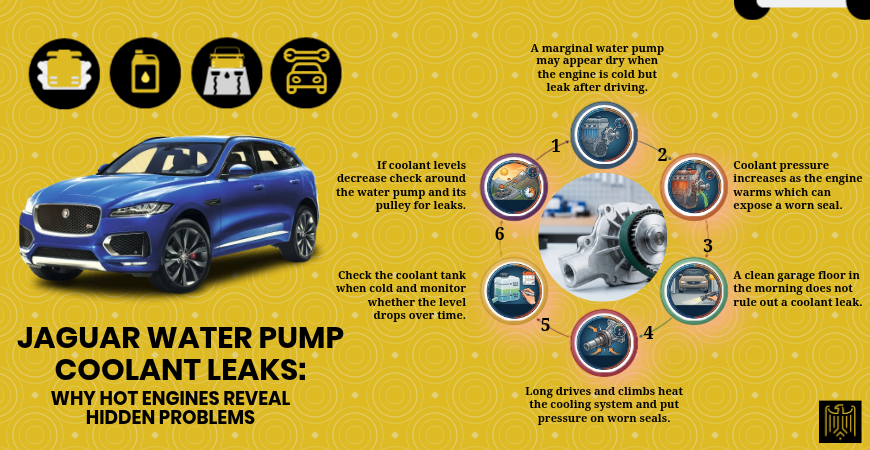
A cooling system builds pressure as it warms, which is why a marginal pump can look dry in the driveway and wet after a drive. You might see a clean garage floor on a chilly morning, then a fresh spot after you park from a long climb.
North County has plenty of those. Valley Center’s long rural roads put real miles between home and town, and every one of those trips heats the system and pushes against a worn seal. Check the tank cold. If the level has dropped since last week the coolant is going somewhere, and the front of the engine, around the pump and its pulley, is a sensible first place to look.
A Pressure Test Separates a Water Pump Leak From Everything Else
Jaguar’s own test pressurizes the cooling system to 1 bar (15 PSI) for 5 minutes. A drop of 1.0 to 1.5 PSI is normal. Anything larger means a hunt for the Jaguar coolant leak itself, and since Jaguar puts UV dye in its coolant, a UV light helps trace it to the exact source.
Escondido German Auto pressure-tests cooling systems rather than just topping them off, which is the right instinct on these engines. The part has changed, too. In a May 2014 product update, Jaguar said the water pump for the 3.0 (AJ126) and 5.0 (AJ133) had been through a major redesign, with the new parts due later that year and compatible with existing engines.
Why Escondido Jaguar Owners Bring It Here
Escondido German Auto has worked on Escondido’s cars for over 20 years, and its Jaguar work is done by ASE-certified technicians who specialize in the brand. The shop uses authentic Jaguar parts. Every repair carries a 2-year/24,000-mile warranty, which matters on a job where the belt has to come off before anyone can reach the pump.
It’s local, too. The shop sits on E. Grand Ave, just east of downtown, an easy run from Rancho Bernardo or San Marcos.
Frequently Asked Questions
Q: Is it normal for a Jaguar water pump to have coolant residue?
A: Yes, a little. Jaguar’s bulletin says some dry residue on the pump body, pulleys or belts is normal and doesn’t damage the pump. Fresh wet coolant dripping from it is the sign of a real leak.
Q: Can I drive my Jaguar with a water pump leak?
A: Gently, and only once it’s topped up with the correct coolant, since mixing types can leave sludge. Watch the temperature gauge, and if the low coolant message returns quickly or the gauge climbs, stop driving it.
Q: How do I know if my Jaguar water pump bearing is failing?
A: Listen right after a cold start, the same moment Jaguar’s bulletin uses. A moan, rumble or grind from the front of the engine is worth reporting, and a technician confirms bearing wear by feeling the pulley for play and roughness.
Get Your Jaguar’s Cooling System Pressure-Tested in Escondido
If the pump only groans on a cold start, record a short phone video of it, because a noise that’s gone by the time the car reaches the lift is hard to describe. Put your model, engine and how often the coolant message appears on the appointment form at escondidogermanauto.com, and an adviser will confirm the visit. The address is 1554 E. Grand Ave, Escondido, CA 92027.