
There is a spot on the driveway most mornings and nothing under the car by the time you get home. The coolant level drops a little each month. You took it somewhere, they ran it in the bay, and nothing leaked, so you were told to keep an eye on it. This is a specific category of leak, and it behaves exactly backwards from what everyone expects, and it is common on the BMW, Mercedes and Audi models we see in Escondido once inland mornings start dropping into the forties.
Plastic and rubber shrink when they cool
Cooling systems are built from materials with very different expansion rates. Aluminum housings, glass-reinforced plastic fittings, rubber hoses, silicone O-rings and steel fasteners all grow and shrink at their own pace as the engine heats and cools.
When everything is hot, those parts are at their largest and they press hard against each other. A hairline crack in a thermostat housing closes up. A tired O-ring gets squeezed into its groove. A warped flange is pulled flat against its mating surface by the expansion of the bolts holding it.
Let the car sit overnight and all of that reverses. Parts contract, clearances open, and the gap that was sealed by thermal expansion is suddenly a leak path. The coolant is still under some residual pressure as the system cools, and it finds the gap.
The leak that stops when the engine warms up
So the pattern looks like this. The car sits overnight. Coolant weeps out and lands on the driveway or the undertray. You start it in the morning, everything expands within a few minutes, and the leak seals itself for the rest of the day.
Drive it hard and you may see nothing at all for a week. Park it for a long weekend and there is a puddle. Owners often connect it to how far they drove or which route they took, when the real variable is simply how long and how cold the car sat.
The most common sources are the plastic thermostat housing, the coolant flange at the back of the head on some Volkswagen and Audi engines, the expansion tank seam, the radiator’s plastic-to-aluminum crimp, and the O-rings on quick-connect fittings.
Why a warm-engine inspection finds nothing
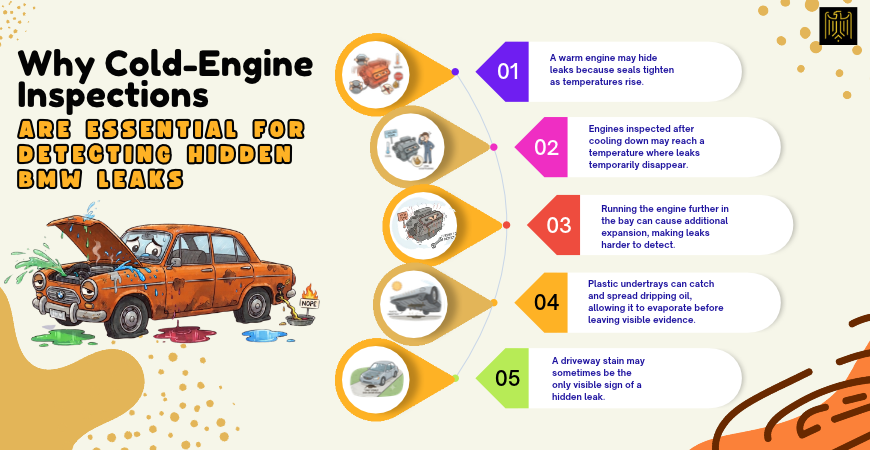
A car that has been driven in, parked in the lot and then put on a lift forty minutes later sits at the exact temperature where the leak does not exist. The inspection can be thorough and the result still comes back wrong.
Running the engine up in the bay makes that worse. Everything expands further, the seal gets tighter, and anyone with a flashlight sees a clean, dry engine. No leak found is the correct result of the wrong test.
Some of these cars also hide the evidence well. Modern European engines carry a full-width plastic undertray that catches the drip and spreads it along the belly pan, where it evaporates. The driveway stain is sometimes the only thing left.
A pressure test works on a cold engine for a reason
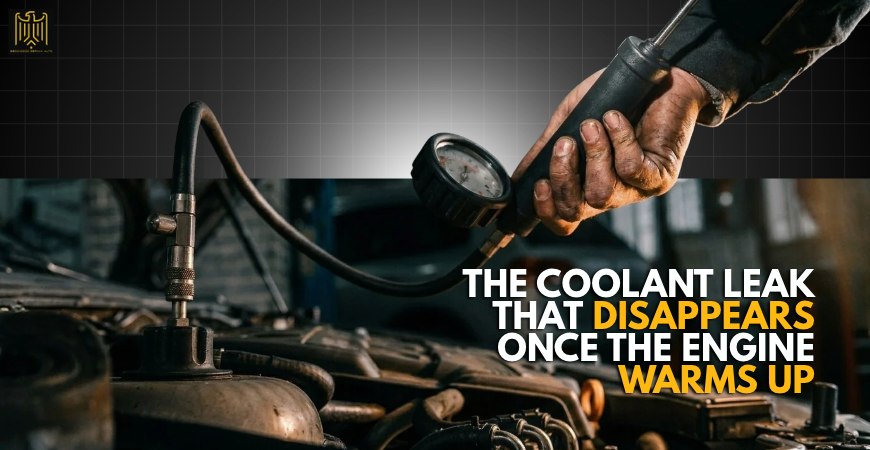
The right test is a cold one. A hand pump threads onto the expansion tank neck and pressurizes the system to its rated pressure without any heat involved, so the parts stay contracted and the gap stays open.
Then we wait and watch the gauge. A system that holds steady for fifteen minutes has no external leak at that pressure. A gauge that creeps down has one, and from there it is a matter of following the pressure to where it is escaping.
This also catches the systems that are losing coolant without any external evidence at all — a head gasket, a cracked head or a failed oil cooler. A system that will not hold pressure with nothing visible outside is telling us the coolant is going somewhere internal, and that changes the whole conversation.
Dye finds what pressure alone does not
For very slow seeps, pressure alone can take hours to produce a visible drop. Fluorescent dye earns its place there.
A small amount goes into the coolant, the car gets driven and then parked long enough to cool properly, and an ultraviolet light shows the escape path glowing bright against the engine. The trail points back to its source even when the actual crack is hidden behind a bracket or above a pulley.
The reason this works where a visual inspection fails is that dye records history. It marks where the coolant went overnight, so the evidence is still on the engine in the morning.
What we do once the source is confirmed
Finding it is most of the work. The repair itself is usually a housing, a flange, a tank or a set of O-rings, and it is a predictable job once nobody is guessing.
Two habits come with it. Aged plastic nearby gets replaced at the same time instead of being left for a second visit, because parts in the same heat environment age together. And the system gets refilled under vacuum and pressure-tested again afterward, since an air pocket will produce a new complaint that looks nothing like the one you came in for.
The case for sorting it out early is partly seasonal. Escondido’s long-term weather record puts the average December low at 41.8 degrees, with January and February in the same range. Through that stretch a cold-only leak marks the driveway every morning and hides all afternoon. A housing and a pressure test is a small job. An overheated engine is not.
Frequently Asked Questions
Q: Why does my car only leak coolant when it sits overnight?
A: Because the parts shrink as they cool and open a gap that thermal expansion seals when the engine is hot. The leak is real, it just does not exist at operating temperature.
Q: Is it safe to keep driving while I wait for an appointment?
A: Usually yes, as long as you check the coolant level cold before each trip and the loss is small. A level that drops noticeably week to week is a different situation and should be looked at promptly.
Q: Will stop-leak products fix this?
A: They sometimes stop the drip and they reliably clog the heater core and the narrow passages in the radiator. We would replace the housing today before chasing a blocked heater core next month.
The First Appointment of the Day Is the Useful One
Leave the car with us cold, before it has been driven, and a pressure test will find in fifteen minutes what a warm inspection cannot find at all.
Escondido German Auto — 1554 E. Grand Ave, Escondido, CA 92027