
You are in traffic on East Grand Avenue, third stop in a row, and the clutch pedal goes soft and stays down. Second gear grinds. Pump the pedal twice and it comes back. Everyone assumes the clutch is finished. Usually it is not — the clutch hydraulic circuit has lost pressure, and the friction disc inside the bellhousing may have years left in it.
Inland Escondido still runs hot into October, and heat is what exposes this fault. Drivers from Valley Center, Poway and San Marcos bring us manual VWs, Audis and Porsches with the same complaint every fall, almost always after a long climb or a slow crawl.
Quick Summary: Key Takeaways
- Soft pedal is hydraulic: A pedal that sinks, needs pumping or has no bite point is a fluid and pressure problem. A worn clutch slips instead, with rpm rising and speed staying flat.
- Check the reservoir: The clutch shares brake fluid on most German cars, so a falling level with no brake leak points straight at the clutch master or slave cylinder.
- Wet carpet is a clue: A master cylinder leaking internally often drips behind the pedal box, and a damp driver’s footwell is a giveaway.
- Fluid age matters: Brake fluid absorbs moisture. Replacing it every two years protects the clutch hydraulics as much as it protects the brakes.
- 2-year, 24,000-mile warranty: Repairs come with photo-documented inspection reports and OEM parts, done by German factory-trained staff.
Three parts move that pedal, and none of them is the clutch
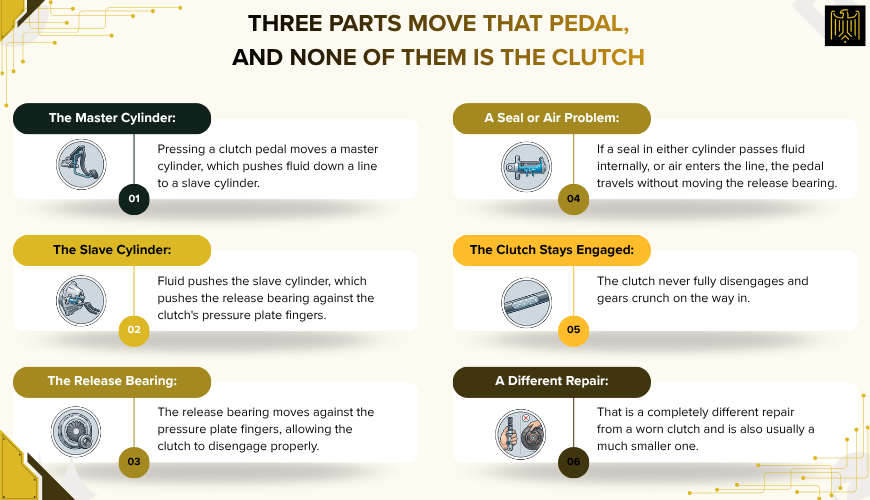
Pressing a clutch pedal moves a master cylinder, which pushes fluid down a line to a slave cylinder, which pushes the release bearing against the clutch’s pressure plate fingers. Fluid does all the work. If a seal in either cylinder passes fluid internally, or air enters the line, the pedal travels without moving the release bearing — so the clutch never fully disengages and gears crunch on the way in.
That is a completely different repair from a worn clutch. It is also usually a much smaller one.
Sorting hydraulic failure from a worn clutch takes two minutes
The two faults behave in opposite ways. Hydraulic failure shows up when you push the pedal: soft feel, sinking, no clear bite point, grinding into first or reverse, and improvement after pumping. A worn friction disc shows up when you release the pedal: engine rpm climbing without acceleration under load, a high engagement point, and a burnt smell after a hill.
Then look at the fluid. If the brake reservoir keeps dropping and the brakes have no leak, the clutch circuit is where it is going, and no amount of pedal adjustment will fix that.
Heat, moisture and traffic cycles wear the hydraulics out
Every stop is a full stroke of both cylinders. Traffic multiplies that count fast, and the Department of Energy’s own figure for aggressive stop-and-go driving — a fuel economy penalty of 10% to 40% — is a decent proxy for how much work a clutch circuit does in it. Thousands of strokes a week wear seals.
Moisture finishes them. Brake fluid is hygroscopic, so it pulls water out of the air through the reservoir cap and the flexible line, and water lowers the boiling point and corrodes cylinder bores from the inside. Add the heat radiating off a bellhousing on a 95-degree Escondido afternoon and a marginal slave cylinder will fail on the climb toward Valley Center rather than in your driveway.
Driving on a failing circuit costs you the gearbox, not the clutch
Grinding gears is metal loss. Every crunch into first or reverse takes material off a synchro ring or a gear dog, and synchro repairs mean the gearbox comes apart — which costs several times what a slave cylinder does. This is the part owners regret.
There is a practical risk too. A circuit that fails completely leaves you unable to select a gear at all, and on a car that has to be shut off to change gear, that means a flatbed rather than a drive home.
How the diagnosis and repair run at our Grand Avenue shop
Diagnosis is physical. Pedal travel and feel get checked, the reservoir level and fluid condition get recorded, the master cylinder and pedal box are inspected for weeping, and the slave cylinder and line are checked at the bellhousing. On models with a concentric slave cylinder inside the housing, you are told upfront that the gearbox has to come out — because that changes the decision, and hiding it is not a service.
The work itself is straightforward: correct parts, a proper bleed, fresh fluid throughout and a road test. Our technicians are German factory-trained and ASE certified, and ASE requires certification to be renewed every 5 years, which is why the credential means something. You get photos of what was found either way.
Frequently Asked Questions
Q: Why does my clutch pedal go to the floor and stay there?
A: Almost always a hydraulic failure — a leaking master or slave cylinder, or air in the line. The pedal moves fluid instead of the release bearing, so the clutch stops disengaging. If the pedal returns after pumping, that is a strong sign the circuit, not the clutch, is at fault.
Q: Can low brake fluid affect the clutch?
A: Yes, on most German cars the clutch draws from the brake fluid reservoir. A falling level with no visible brake leak usually means fluid is escaping from the clutch master or slave cylinder, and topping it up without finding the leak just delays the failure.
Q: How much does it cost to fix a clutch slave cylinder?
A: It depends entirely on where the cylinder lives. An external slave cylinder is a modest job; a concentric unit mounted inside the bellhousing requires the transmission to come out, which is why the clutch and release bearing are usually replaced at the same time. Get the design confirmed before comparing quotes.
Q: How often should clutch fluid be replaced?
A: Every two years, together with the brake fluid, because it is the same fluid and it absorbs moisture from the air. Old fluid is the leading cause of corroded cylinder bores, and a fluid service is far cheaper than the cylinder it protects.
Bring it in before the gearbox pays for a small part
A soft pedal is a small repair caught early and a big one caught late. Bring the car to our East Grand Avenue shop and you will get a straight answer on whether this is hydraulics or clutch, with photos to back it up.
Hours: Monday to Friday, 8:00 AM to 5:00 PM. Closed Saturday and Sunday.
Website: escondidogermanauto.com