
German Transmission Repair in Escondido
Your Audi shifts hard the first mile out of the driveway, then smooths out by the time you hit Valley Parkway. German automatics are precise, computer-controlled, and expensive to replace — which is exactly why they get replaced when they didn’t need to be. A modern eight-speed fails hydraulically, electrically, or mechanically, and those faults produce overlapping symptoms. We work it in the order that saves Escondido drivers money: find the fault, then fix the fault.
Quick Takeaways
- Most transmission symptoms aren’t a dead transmission: solenoids, wiring, mounts, and burnt fluid mimic internal wear at a fraction of the cost.
- We test before we quote: road test, fault codes, live pressure and slip data, fluid condition, then a decision.
- Heat is the enemy: the I-15 crawl toward Rancho Bernardo and the 78 climb cook transmission fluid faster than open freeway does.
- Sealed doesn’t mean never serviced: we service gearboxes the brochure called lifetime-filled, using fluid matched to the exact factory spec.
- A rebuild quote without testing isn’t a diagnosis: it’s a guess with a big number on it.
The symptoms that tell you your German transmission needs attention
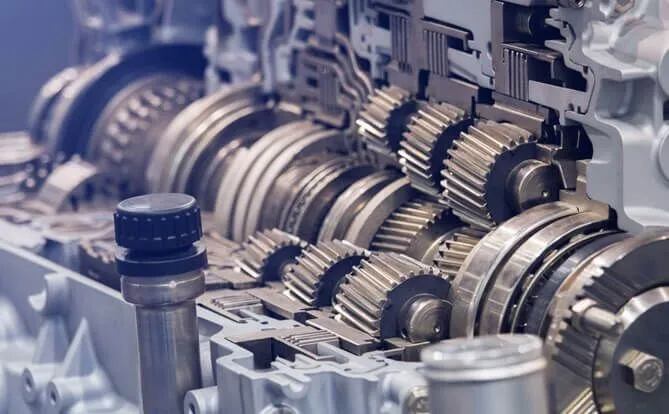
Transmission trouble follows a progression, and where you are in it matters more than the symptom itself. A hard or clunky shift when cold that smooths out once warm usually points to fluid condition or a sticking valve body solenoid — not internal damage. The valve body is the hydraulic control plate inside the transmission: a maze of passages and electric valves, called solenoids, routing pressurized fluid to the right clutch pack at the right moment.
From there: the gearbox hunting between two gears on a grade. A flare, where engine RPM jumps between shifts because nothing is holding. Hesitation of a second or two before the car moves after you select drive. A shudder at light throttle around 35 to 45 mph — usually torque converter lock-up, the clutch inside the fluid coupling between engine and gearbox that ties the two together at cruise. Harsh downshifts coming to a stop. Then limp mode: the computer finds a fault it can’t work around, locks the transmission in one gear, and warns you on the dash to get home slowly. On dual-clutch gearboxes, add a jerky crawl in traffic.
Here’s the part worth reading twice. Most of those symptoms are not a failed transmission. A solenoid, a valve body, a chafed harness, a failing engine mount, or fluid that’s gone dark and lost its friction properties all produce symptoms nearly identical to worn internal clutches — at a fraction of the cost. Anyone who quotes a rebuild before testing hasn’t diagnosed it.
What we do when you come in with a transmission complaint
We reproduce it before we touch it. The road test comes first, and we note exactly which gear, which speed, and what load the symptom appears under — a shudder at light throttle is a different fault than a bang at full throttle.
Back in the bay, we pull fault codes from the transmission control module and read live data: line pressure, gear commanded versus gear achieved, and slip counters logging how much each clutch pack slips. That comparison alone separates an electrical fault from mechanical wear. Then fluid level and condition, using the correct temperature-dependent procedure — most modern German automatics have no dipstick, and level is only valid inside a specific fluid temperature window. We check the mounts, because a failing mount lets the drivetrain move and feels exactly like a bad shift. And we inspect the harness where it enters the gearbox — a chafed connector throws codes that look internal.
Only then do we decide: transmission fluid and filter service, valve body or mechatronic repair (the mechatronic unit combines valve body and control computer, used on many VW and Audi gearboxes), a single solenoid, or internal repair. Then we tell you which one it is, with the data in hand. Manual car? That’s German clutch repair instead.
Why Escondido drivers bring transmission work to us
We diagnose before we condemn. We look for the repair that fits the fault instead of defaulting to replacement, and we service gearboxes the brochure called sealed — “lifetime” was never defined as your lifetime.
Fluid matters more than most people expect. We use manufacturer-approved fluid to the exact specification, because the wrong ATF changes clutch pack friction and causes the shudder it was supposed to fix. ASE Certified mechanics, German factory-trained staff, and a 2-Year/24,000-Mile warranty on every repair.
Heat kills automatic transmission fluid, and inland Escondido delivers it. The I-15 crawl toward Rancho Bernardo, the climb on State Route 78 — slow speeds under load, little airflow through the cooler, converter slipping and making heat instead of transmitting it. Hardest duty cycle a converter sees. Towing up the grades to Valley Center compounds it. Driving style loads a transmission the way it loads fuel: aggressive driving lowers gas mileage roughly 15% to 30% at highway speeds and 10% to 40% in stop-and-go traffic, and that wasted energy becomes heat your fluid absorbs. We do this work across all 15 makes the shop services — Alfa Romeo, Audi, Bentley, BMW, Ferrari, Jaguar, Lamborghini, Land Rover, Maserati, Mercedes-Benz, MINI, Porsche, Rolls Royce, Sprinter and Volkswagen.
Frequently Asked Questions
Is my transmission going out, or is it something else?
Often something else. Failing mounts, a bad wheel speed sensor, a misfire, or a chafed harness all feel like transmission trouble from the driver’s seat. Codes and live data separate them.
How much does a BMW transmission repair cost?
We don’t quote before testing. Cost tracks which layer failed — a solenoid or fluid service at one end, a mechatronic unit in the middle, internal repair at the top — plus whether the gearbox has to come out, and fluid volume.
Do German cars need transmission fluid changes if it says sealed?
Yes. Sealed means no dipstick, not no service. Fluid degrades with heat, and inland North County heat is real. Ask us about interval based on how you actually drive.
Why does my car shift hard when cold but fine when warm?
Cold hard shifts that clear up warm usually point to fluid condition or a sticking solenoid rather than worn clutches. One of the more fixable patterns we see.
What does limp mode mean on an Audi?
The computer found a fault it can’t compensate for and locked the gearbox in one gear to protect it. Drivable at low speed. Get it read before driving far — the stored code is the fastest route to the cause.
Bring the car to Escondido German Auto, 1554 E. Grand Ave, Escondido, CA 92027, open Monday through Friday, 8:00 AM to 5:00 PM, and closed weekends. Tell us what the light was doing and how the car felt. Schedule your check engine light diagnosis at https://escondidogermanauto.com/.