
Engine Repair in Escondido for BMW, Audi, Mercedes-Benz and Other German Cars
Most engine repairs we do didn’t start as engine repairs. They started as a noise, a dash light, or a coolant level that dropped every month. German engines don’t tolerate being ignored. A plastic thermostat housing that lets go climbing the 78 in August can cost you a head gasket. We’re on E. Grand Ave in Escondido, and the engines on our lifts cover the German lineup — BMW, Mercedes-Benz, Audi, Volkswagen, MINI, Porsche, Sprinter — plus Jaguar, Land Rover, Alfa Romeo, Maserati, Bentley, Ferrari, Lamborghini and Rolls-Royce. Bring us the symptom early, and the repair stays small.
Quick Takeaways
- A cold-start rattle that fades after a few seconds: usually a timing chain guide or tensioner. It gets worse, never better.
- Coolant disappearing with no puddle underneath: often a cracked plastic housing or split expansion tank that seeps only when hot.
- We test instead of guessing: leak-down, pressure and smoke tests, plus a camera down the intake before anyone sells you a valve cleaning.
- Every engine repair carries a 2-Year/24,000-Mile warranty: parts and labor, on manufacturer-approved parts.
The symptoms that tell you your German engine needs attention
Engine trouble follows a pattern, and the pattern tells us where to look. A misfire you feel at idle but not at highway speed points at one coil or injector. A rattle on cold start that quiets after a few seconds is oil pressure reaching a worn timing chain tensioner or a cracked chain guide. A tick that rises with engine speed is usually valvetrain. Blue smoke on startup, or a quart gone between changes, means oil slipping past valve guide seals or rings. Coolant that vanishes with no spot on the driveway is almost always a plastic part weeping under pressure.
Watch the temperature gauge. A needle that climbs in traffic on Valley Parkway and settles on the freeway is a cooling system failing — water pump, thermostat, or fan — not a sick engine. Rough running with a hiss is a vacuum leak or a ruptured crankcase ventilation valve. Power falling off under boost on a turbo car means a leaking charge pipe, a wastegate, or a boost sensor. A sweet smell after shutdown is coolant on something hot.
Two systems decide how bad this gets: cooling, and the timing drive. Ignore either and a manageable repair becomes an expensive one. Overheat a German aluminum engine once, and you’re into head gaskets. Let a chain guide crumble, and the chain jumps, which bends valves.
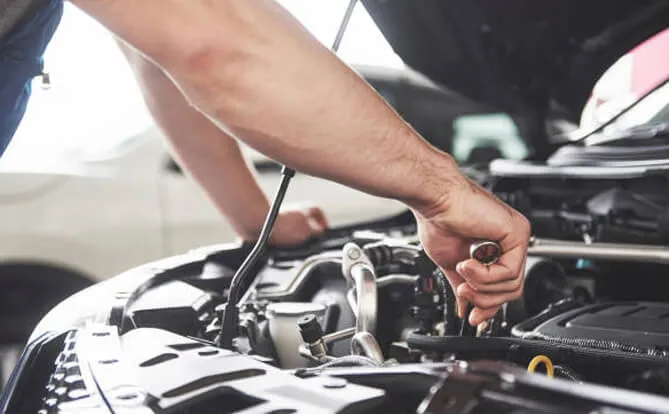
What we do when you bring your car in for engine work
We verify, then we test. First a road test, so we’ve felt what you felt. Then we pull manufacturer-specific fault codes — the kind a generic code reader never sees — and read live data: fuel trims and per-cylinder misfire counters. Fuel trim is how much extra or less fuel the computer adds to keep the mixture right; a big positive number on both banks means unmetered air is getting in. Misfire counters name the cylinder.
From there we test instead of assuming. Suspect internal wear and we run compression and a leak-down test: we pressurize a cylinder with air and listen for where it escapes, which separates rings from a valve from a head gasket. Cooling complaints get a pressure test. A rough idle gets a smoke test: harmless vapor into the intake, then we watch where it drifts out. On a direct injection engine, meaning fuel sprayed straight into the cylinder instead of the intake port so no gasoline washes the back of the intake valves, we borescope the ports and look at the actual carbon before quoting a cleaning.
Then we tell you what’s urgent and what can wait, and why. That check engine light could be as minor as a loose gas cap, or serious enough to hurt fuel economy, raise emissions, and lead to costly repairs later. The decision stays yours.
Why Escondido drivers bring engine work to us
Depth and tooling. Our staff is German factory-trained, and we use manufacturer-approved equipment and factory-grade tools, which matters on jobs where the procedure is the repair: setting chain timing, torquing head bolts in the right sequence. Timing chain and cooling system work happens in our bays, not at a subcontractor across town.
Parts matter as much. A thermostat housing from the correct supplier lasts; a cheap one comes back, and you pay the labor twice. Same with fluid: using the manufacturer’s recommended grade of motor oil improves gas mileage 1% to 2%, and the wrong grade lowers it. That’s why we’re particular about the oil change and factory scheduled maintenance intervals. Sustained inland heat is the local factor nobody accounts for. Commuters running I-15 down to Rancho Bernardo and Poway, or climbing State Route 78 toward the interchange, work a cooling system harder than any coastal drive, and heat is what makes German plastic coolant parts brittle. Everything we repair carries a 2-Year/24,000-Mile warranty.
Frequently Asked Questions
Why does my BMW rattle for a few seconds on cold start?
Usually a worn chain tensioner or a broken plastic chain guide. Oil drains down overnight, the chain sits slack, and it slaps until pressure builds. It won’t heal.
My car is losing coolant but there's no leak on the ground — where is it going?
Usually a plastic part that seeps under pressure and evaporates off a hot surface: thermostat housing, expansion tank seam, or coolant pipe. A pressure test finds it. Less often it’s burning inside a cylinder — white exhaust.
How much does German engine repair cost?
We quote after diagnosis. Cost is driven by access — how much comes off to reach the failed part — whether the engine must come out, how many gaskets get disturbed, and whether heat spreads.
Is burning a quart of oil between changes normal?
Some German engines use a little by design, but a quart every thousand miles or blue smoke isn’t something to live with. It fouls plugs and loads the catalytic converter. Rule out oil leaks first, then valve seals
Do direct injection engines really need carbon cleaning?
Many do eventually, but only if the deposits are there. We look with a borescope first. Clean valves mean you keep your money.
Escondido German Auto is at 1554 E. Grand Ave, Escondido, CA 92027, open Monday through Friday, 8:00 AM to 5:00 PM, closed weekends. See the full service list at escondidogermanauto.com. If the noise, the light, or the coolant level is bothering you, schedule your engine service, and we’ll start with a road test.